"How much house can I afford in Canada?"
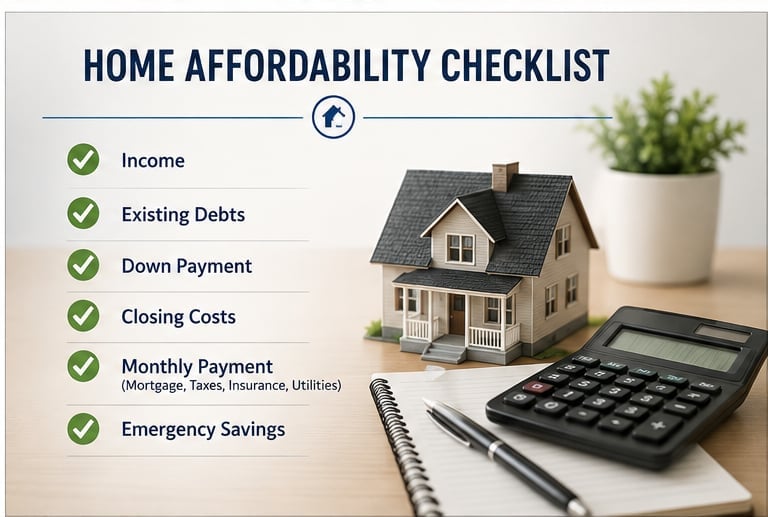
The honest answer depends on more than your income. Your down payment, existing debts, credit, property taxes, heating costs, mortgage rate and amortization all affect what a lender may approve.
But there is another number that matters just as much:
What can you comfortably afford without feeling stretched every month?
A mortgage pre-approval may tell you the maximum purchase price available based on lender guidelines. It does not automatically tell you whether that payment will fit comfortably alongside groceries, childcare, transportation, savings, home repairs and the rest of your life.
This guide explains how mortgage affordability works in Canada, what lenders consider and how to build a home-buying budget that still feels manageable after closing day.
If you are trying to understand how much house you can afford in Manitoba — whether you're buying in Winnipeg, Brandon, Steinbach, or anywhere in between — local property taxes, condo fees, commuting costs and home prices should all be included in the calculation. This guide is built with Manitoba buyers in mind.

Your income is an important part of mortgage qualification, but it is only the starting point.
Two households earning the same amount can qualify for very different mortgages.
For example, one household may have:
Another household earning the same amount may have:
Their gross incomes may match, but their mortgage options probably will not.
When determining how much house you can afford in Canada, a lender will generally review: gross household income, down payment, credit history, monthly debt payments, mortgage interest rate, amortization period, property taxes, estimated heating costs, condo fees (where applicable), and the type and location of the property.
This is why an online mortgage affordability calculator can be a useful starting point, but it should not be treated as a final approval.
A proper mortgage pre-approval looks at the actual details behind the numbers.
Canadian lenders use debt-service ratios to determine how much of your gross income may reasonably go toward housing and other debt payments.
The two main calculations are:
Your Gross Debt Service ratio, commonly called GDS, measures how much of your gross household income would go toward basic housing costs.
This typically includes:
CMHC generally restricts GDS to 39% for its insured mortgage guidelines.
Your Total Debt Service ratio, or TDS, includes your housing costs plus other monthly debt obligations.
That may include:
CMHC's standard maximum TDS threshold is generally 44%.
These are qualification guidelines, not a recommendation to spend 39% or 44% of your gross income every month. A lender may determine that the mortgage technically fits within the allowable ratios. You may still decide that the resulting payment is too high for your lifestyle or future plans. That distinction matters.
When determining how much mortgage you can qualify for, lenders do not always use the rate you will actually pay.
For many mortgages, borrowers must qualify using the higher of:
This is commonly referred to as the mortgage stress test.
The purpose is to test whether your finances could handle higher payments if rates or household expenses increased.
As of August 2026, OSFI continues to set that minimum qualifying rate for most newly underwritten uninsured mortgages. You can review the current rule on the OSFI minimum qualifying rate page.
For example, if your contract rate were 4.25%, you may need to qualify as though the rate were 6.25%.
That does not mean you will pay 6.25%. It means the lender is testing your ability to manage the mortgage under more difficult conditions. The stress test can reduce the maximum mortgage amount available, especially when someone is already carrying other debts.
This is the part buyers should spend more time thinking about.
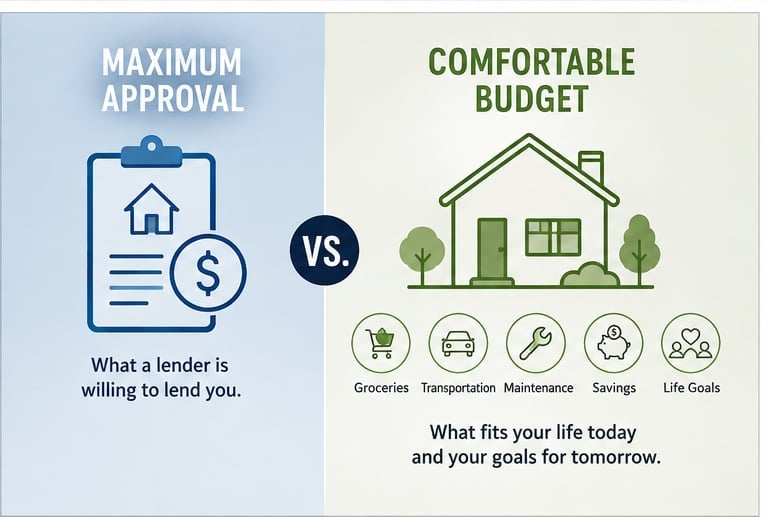
A maximum mortgage approval answers the question: How much is a lender prepared to lend me?
A comfortable home-buying budget answers a different question: How much can I spend while still having room for everything else that matters?
Those are not interchangeable.
Suppose a household is approved to purchase a home for up to $700,000. They may be able to make the payment on paper.
But what happens after adding:
What if one person takes parental leave? What if the furnace needs to be replaced? What if the household wants to travel, invest, start a business or have another child?
The maximum approval does not automatically account for every personal goal.
You can qualify for the house and still dislike the monthly life it creates. That is why the answer to "How much house can I afford in Canada?" should not come from a lender formula alone. It should also come from your actual budget.
The mortgage is usually the largest homeownership expense, but it is not the only one.
Before deciding how much house you can afford in Canada, build these costs into your budget.
Property taxes vary by municipality and property value. They may be paid directly to your municipality or collected as part of your mortgage payment, depending on the lender and mortgage structure.
Your lender will generally require appropriate property insurance before the mortgage advances. The cost may depend on the home, location, replacement value and coverage selected.
Depending on the property, you may be responsible for:
A larger or older home may cost more to heat and maintain than a smaller property, even when the purchase prices are similar.
Condo fees can significantly affect mortgage affordability. Lenders generally include a portion of condo fees when calculating debt-service ratios, but your household budget still needs to account for the entire payment. CMHC's insured-mortgage calculations typically include 50% of applicable condo fees in GDS and TDS.
You should also review what the fee covers, the condominium's financial statements and whether major repairs or special assessments may be coming.
Homes need ongoing work. Some years may be inexpensive. Others may bring a roof repair, appliance replacement, plumbing problem or heating-system failure. A mortgage approval does not create an emergency fund for you. That needs to be part of your own planning.
Your down payment is not the only cash required to complete the purchase. Closing costs may include:
The Financial Consumer Agency of Canada recommends preparing for closing costs of approximately 1.5% to 4% of the purchase price. On a $600,000 home, that could represent approximately $9,000 to $24,000 in additional costs, depending on the property and location.
Do not use every dollar you have for the down payment and assume the rest will work itself out.
Your down payment affects both the size of your mortgage and the type of financing available.
Under current federal rules, the minimum down payment is generally:
A mortgage with less than 20% down will typically require mortgage default insurance.
Putting more money down can reduce the mortgage amount and monthly payment. But there is another side to consider.
Putting every available dollar into the home could leave you without savings for:
The largest possible down payment is not automatically the smartest choice. The right down payment should balance affordability with financial flexibility.
A longer amortization spreads the mortgage over more years, which can reduce the required monthly payment.
For insured mortgages with less than 20% down, a 30-year amortization may be available when the borrower is a first-time buyer and/or is purchasing a new build. Other insured purchases are generally limited to a 25-year amortization.
A lower payment can help with monthly cash flow and mortgage qualification. However, stretching the mortgage over more years generally means paying more total interest if the mortgage remains outstanding for the full amortization.
So the question is not simply: Which amortization gives me the lowest payment?
It is: Which amortization gives me a manageable payment while still supporting my long-term plan?
Some buyers may prefer the breathing room of a longer amortization and then use prepayment privileges when their budget allows. Others may prefer a shorter amortization and faster principal repayment.
There is no one-size-fits-all answer.
In many cases, buying below the maximum approval can be a smart move.
It may leave more room for:
But there is no universal rule saying every buyer should stay a specific percentage below their approval.
Someone with stable income, no debt and significant savings may be comfortable closer to the maximum. Someone with variable income, young children, high transportation costs or major future plans may want a larger buffer.
The better question is: How does the payment feel inside your real monthly budget? Not the budget you hope to follow. The one you actually live with.
Here is a practical way to build your home-buying budget.
Lenders primarily work with gross income, but your household operates using the money deposited into your bank account. Start with what you actually bring home after deductions.
Include:
Do not create an unrealistic "perfect month" budget where nothing goes wrong and nobody spends money.
Add the expected:
This gives you a much better picture than looking at the mortgage payment alone.
Homeownership should not require you to stop saving completely. Try to preserve room for:
Ask what would happen if:
You do not need to prepare for every possible disaster. You do need enough margin that one unexpected bill does not derail the entire household.
Once you know what feels manageable, compare that number with what lenders may approve.
The lower of those two numbers is often the more useful purchase budget.
First-time buyers face the same qualification rules, but they may also have access to programs that help with the down payment.
For example:
Learn more about first-time home buyer mortgages and how these programs may fit into your plan. These programs can help make a purchase possible, but they do not replace proper budgeting.
A buyer may have enough money for the down payment and still need to determine whether the monthly cost is sustainable.
First-time buyers should also avoid using every available dollar just to reach a higher purchase price. Keeping a financial buffer after closing can be more valuable than buying at the very top of the approved range.
Before booking showings, complete these four steps:
A proper pre-approval should involve more than entering numbers into an online calculator. Have your income, credit, debts and down payment reviewed so you understand what may realistically be available.
Decide what monthly payment works before seeing a property you love. It is much harder to reduce your budget after becoming emotionally attached to a home.
Confirm your down payment, closing costs and an emergency reserve are all accounted for before you begin making offers.
A pre-approval is not a final approval of a specific property. The lender still needs to review the home, documents and full application. Depending on the file, an appraisal or other property review may also be required.
A financing condition gives you time to confirm that everything works before the purchase becomes firm.
When asking how much house you can afford in Canada, do not focus only on the maximum mortgage available.
Qualification matters. But comfort matters too.
The right purchase price should let you own the home, cover your normal expenses, continue saving and handle the occasional surprise without feeling like every month is a financial emergency.
That number will be different for every household.
Your income matters. Your debt matters. Your down payment matters.
But so do your children, your career plans, your lifestyle, your savings goals and how much financial breathing room helps you sleep at night.
A lender can tell you the maximum. A good mortgage plan should help you find the number that actually fits your life.
Thinking about buying a home in Winnipeg or across Manitoba? Reach out before you start shopping. We review your income, debts, down payment and monthly budget to determine both what you may qualify for and what purchase price could feel comfortable for you.
No pressure. No guessing. Just a clear plan based on your numbers.